Ancient Roman Daily Life Part II: ten facts about ancient Rome you never knew you needed to know.
This is part 2 of our facts about ancient Rome, and how its traditions and customs still influence Italian culture today.
Missed the first part? No problem - catch up with those first five fascinating facts, here.
This article is a long one. If you're particularly interested in one specific subject, these are links to the different sections where we cover the ancients' love of gadgets, architecture, music halls and cinemas, districts and postcodes, and flags.
Or, just keep reading!
# 6: Ancient Romans loved their gadgets.
Wind chimes in ancient daily life.
 |
| British Museum exhibit. Photo by Cath. |
The ancient Roman Empire was a time and place for innovation. The inspiration of Greek and Egyptian cultures and the introduction of their metals, gems and crafting traditions played a critical part not only in ancient jewelry but in the introduction of everyday items of ancient Roman daily life, many of which still play a large part in our lives today.
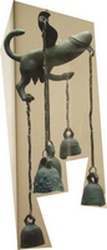
Take wind chimes. Bronze chimes like these were hung in gardens and porticoes to chime softly in the wind, exactly as they are used today.
They differed from today's wind chimes in that the design most popular then would be likely to cause some controversy today: the bells and phallus combined were believed both to keep off evil spirits and to bring good luck to the household.
And, of course, it was a question of the larger, the better.
Candles.
Candles have been used for thousands of years but those we know today count as one of the key ancient Roman inventions because the people of the Empire were the first to use wicks.
Tallow, an extract from cattle and sheep, was melted until liquid and poured over fibres of flax, hemp, or cotton which acted as the wick.
These candles were used in the daily life of ancient Rome for religious ceremonies, and as lighting for travel and homes. The major problem with early candles was that tallow did not burn cleanly, so they both smelled and smoked badly.
 |
| Photo taken at the British Museum by Cath. |
The child's potty!
Two more well known facts about ancient Rome are that the Romans developed very distinctive and fine types of red and brown pottery for the table, and that they were responsible for the development of the first complex plumbing and sewage systems, which are used extensively in the Roman baths which have survived until the present day.
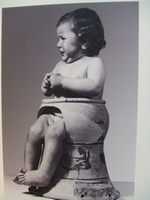
What is perhaps not so well known is their putting together of those two skills and coming up with the first example of a child's potty.
We know from the writings of ancient Roman daily life that children were a very important part of the Empire. They were, after all, its future.
Children's education was conducted mainly by parents, with the emphasis on moral rather than intellectual development. Writings from ancient Roman daily life tell us that the most important virtues for a child were seen as reverence for the gods, respect for the law, unquestioning obedience to authority, truthfulness, and self-reliance.
To those it seems it would be apt to add potty training. This potty dates from the 6th Century B.C. and, judging by the expression on the toddler's face, was not terribly comfortable!
#7: In the modern world of massive technological advancement, Ancient Roman architecture is still a world record beater.
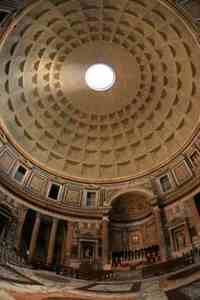
Take the Pantheon in Rome, for example. It was a hugely important part of the ancient Romans' daily life.
As well as being one of the world's oldest standing buildings it has the largest un-reinforced concrete dome in the world, ever. At 43.4 metres its diameter is exactly equal to its height. It's almost half the size of a soccer pitch and over one third the length of an American football pitch.
Although an inspiration for many other world famous domes, it surpasses them all. It is two feet wider than the dome of St Peters' Basilica, three feet wider than the dome of the Basilica di Santa Maria del Fiore in Florence and a massive thirty-two feet bigger than the dome of St Paul's Cathedral in London.
The oculus, or 'eye', at its centre is the only source of light in the building.
The date stamped on many of its bricks mean we know the Pantheon was built as early as 27 B.C. and rebuilt in 123 A.D., but despite such early construction it was created entirely without steel reinforcing rods and with what we would think of now as inadequate tools and unsafe means of lifting the immensely heavy materials.
How this dome was built under such circumstances has been the source of great speculation.
It is likely that one ring of concrete, built like a low wall, was laid on another slightly larger ring, the cement allowed to set and strengthen in order to support the next upper ring.
The circular part of the upper dome was probably placed by using wooden scaffolding.
The whole process of building the dome alone is thought to have taken somewhere in the region of four years. It was yet another triumph for the ancient Roman Empire, and has yet to be rivalled in our modern world.
#8: The ancient Romans were the originators of Odeon cinemas.
Ever heard of the Odeon Leicester Square?
If you're interested in films you certainly will have. It has hosted countless royal galas, star-studded premieres and for the last four years has been home to the BAFTA awards ceremony. In Hollywood the Odeon is so well respected that it is referred to as "The Cathedral."
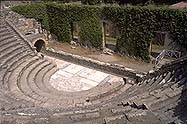 |
| Remains of Odeon at Pompeii |
It will probably not surprise you to learn that the Odeon has its roots in ancient Roman daily life.
Originally a feature of Greek culture, the first 'Odeum' was built in Athens in about 435 B.C. and adopted into ancient Roman culture as the Empire grew.
A comparatively small, roofed building, it was a kind of ancient music hall cum theatre in which musicians and orators both performed and competed.
The indoor theatre came about because the large, open areas in which entertainment was originally held were full of distractions from passers-by and other nearby entertainments, not to mention being acoustically poor.
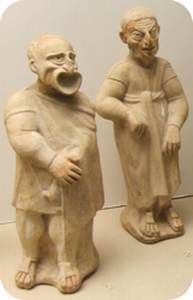 |
| Model of actors wearing masks. Photo taken by Cath, at British Museum. |
Ancient Roman theatre was heavily influenced by Greek tradition, and as with many other literary genres Roman dramatists tended to adapt and translate from the Greek.
However, true to Italian culture, traditions and personality the ancient Romans were always keen to enjoy themselves. They found tragedies too depressing for the stage, and the deep and meaningful questions raised by Greek plays too challenging.
Preferring both excitement and laughter, plays about war were always popular. But above all Romans enjoyed comedy - the lewder the better.
Because of the drunkenness, obscenity, adultery and semi-naked dances on stage, actors, who were highly respected in Greece, were held in utter contempt in ancient Roman daily life.
By the end of the Roman Empire a particular type of mime drama had begun to emerge whereby one actor played many parts, wearing masks to indicate mood, while a chorus narrated or told the story.
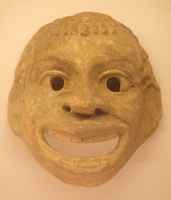 |
| Terracotta mask. Photo taken by Cath at British Museum. |
Masks were worn by tragic and comic actors alike. Made of linen, they have not survived. This terracotta mask (right) is an ancient copy of a linen original.
Nero, Emperor of Rome, considered himself a virtuoso in - amongst other things - music, acting and literary activity. He regularly performed in the Odeum. Those who watched him thought his performances fairly poor; indeed many people are reported to have fallen asleep during his appearances.
His answer to that was to kill his audience if they did not display the appropriate level of attention and enthusiasm. A little over the top, perhaps!
Not one to show much humilty, Nero's own death was marked above all by the statement, "Qualis artifex pereo" : what an artist dies in me. But the people of ancient Rome begged to differ.
So the present Italian culture, traditions and customs of celebrating the arts in street theatre, music and dance which you'll see everywhere in Italy, began with the customs of ancient Roman daily life.
Entertainment in the Empire may have been frowned upon by the state, who were concerned about their culture declining into sloth and decadence. But certainly the lower classes attended in their hordes, and did not seem overly concerned with their own moral decline!
#9: Ancient Roman maps show that the Romans used postcodes.
Modern maps of Rome, as might be expected of a large urban area, show it divided into twenty-two districts. Like the structure of many cities, its formation is an echo of its past as a large Roman military settlement.
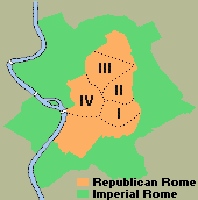
However what is not as well known is that Rome has always had the equivalent of our modern postal districts. This map of ancient Rome (left) shows that there were originally four neighbourhoods, based on four of the hills surrounding the city. The area was surrounded by Rome's earliest set of walls.
As the city expanded and evolved, Emperor Octavianus Augustus increased the regions.
According to this second map, ancient Rome had by then expanded and was divided into fourteen, to include urban areas built outside the original walls.
Those districts were used for administrative purposes and like, for example, the Paris 'Arondissements' of today were referred to both by name and by number.
Ancient Roman maps tell us that this organisation of the city remained in place for several centuries.
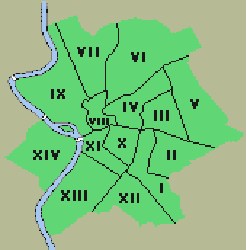
Like any modern zip or postal code, some areas were more desirable than others. The heart of ancient Roman daily life was the city and the religious and defensive core: district VIII - the Capitoline. Here stood the Forum and the Temple of Jupiter. It was not an area frequented by 'plebs'.
The best district to live in was Region X, the Palatine. At twenty-five acres of opulent homes for Emperors, it was the heart of Imperial Rome. Romulus, the founder of Rome, lived there as did Cicero, Pompey and Mark Anthony.
The less salubrious districts were Region IV, the Subura valley, and XIV, the Transtiberim. This was the area to the west of the river and home to most of the immigrant population of Rome.
To this day still numbered as district XIV and known as the Trastevere, its name taken directly from the Latin origin, this is now one of the most popular of Rome's current twenty-two districts. Its unique character continues to attract foreign expatriates and artists.
Faithful to its origins in ancient Roman daily life, it remains open to influences from outside, whilst retaining its deeply Roman character.
#10: Ancient Roman flags were the football logos of their day.
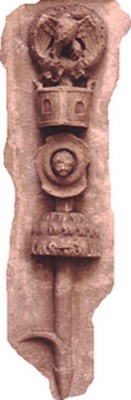 |
| Stone carving of an early standard : this one has an eagle at the top. |
There are those who will say that there is no such thing as an ancient Roman flag. It's certainly right that they did not initially exist in ancient Roman daily life in exactly the form flags currently take.
But the history of distinctive, easily seen symbols to identify military units is as old as war itself. Indeed, the English word "vexillology", the study of flags, comes directly from the Latin word "vexillum" meaning both a flag and an army company.
Each part of the ancient Roman army had its own ensign. The large unit or legion had a specific symbol. Each cohort within the legion had its own, and each minor division of each cohort also had its own emblem, generally inscribed with the number of the cohort and of the century.
Their purpose was simple: to act as a rallying point and make it easier for each soldier to see exactly where he should be standing.
Those symbols began as a rigid motif, often a carved animal, mounted on a metal or wooden pole. We know from both the graffiti of ancient Roman daily life and the writings of Pliny that there were originally five such animals: the wolf, horse, wild boar, minotaur and eagle.
Others, based on astrological signs also became popular: the bull, capricorn, and lion. Each emblem was a symbol of strength, power and good fortune.
Legions raised by Caesar originally carried a bull emblem. Those of Augustus were mostly a capricorn but by far the most popular of the emblems, and even now recognised as a symbol of the power of the Roman Empire, was that of the eagle.
Shortly before the Christian era it was decreed that the eagle alone be retained as the sole standard at the head of every legion.
And so it became the standard of the Roman Empire and is still recognised as such today.
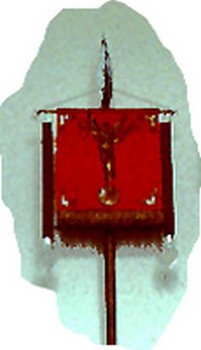 |
| Replica of an early Roman flag. |
The fabric flags we know now were developed when squares of cloth attached to spears were draped over a general's tent to signify readiness for battle. The fabric would then be draped over the standards for decoration and, in time, were carried separately into battle.
As the power of the Roman Empire grew, the standards themselves became amongst the most important symbols of power in ancient Roman daily life. The sight of them alone would cause great fear amongst the enemies.

Regimental Colours, the modern Army's equivalent, are no longer carried into battle. But there is a modern day equivalent - the flag of football fans.
Instantly recognisable to fans, many carry symbols of powerful animals and some, like that of Lazio, bear the eagle as a motif.
And ther's a further parallel, demonstrated in the comment made by Tertullianus in the 2nd Century B.C. about the fervour of the ancient Roman army: "the religious system of the Roman army is entirely devoted to the worship of the standards"
Consider the almost religious devotion with which soccer fans now follow their club and wear their colours. Yet again, modern culture mirrors ancient Roman daily life.
Where to go to learn more facts about ancient Roman culture.

This one is my favourite:
The British Museum, London, U.K.
- Contains a wealth of exhibits related to ancient Roman culture and everyday life. Its sheer size can be quite overwhelming - make sure you get a plan of the building at the information desk by the entrance.
The staff here are particularly good with children and will actually allow them to touch some of the exhibits usually behind glass. There are also free explanatory tours of the exhibits - keep an eye out for the posters and signs around the halls.
The book shop at the Museum has a wide range of books on ancient Rome including some good children's books and the gift shop sells replicas of some exhibits, particularly ancient Roman jewelry. - Museo Archeologico Nazionale di Napoli, Naples, Italy
- Museo Nazionale Romano, Rome, Italy
- Museo della Civiltà Romana, Rome
- The Roman Forum, Rome
- San Antonio Museum of Art, Texas, U.S.
If you enjoyed this article, you may be interested in these, too.
All images on this page, unless otherwise specified, are courtesy of the VRoma.com project.
If you found this article interesting, we'd love it if you'd click this little "Like" button - thank you!


Recent articles.