Home
Ancient Culture Ancient Culture
Ancient Weddings
City Culture Rome
Rome for kids
Winter in Rome
Rural Culture Animals in Italy
Valentine traditions Words of love
Valentine's, Liguria
Homemade gifts
Make biscotti
Just for you! e-Coffee shop
Free e-cards!
This is us!
Get in touch


Ancient Roman Culture: where Italian culture traditions started.


Ancient Roman culture in daily life : understand Italian culture and history before you visit.

"Rome is not a human habitation but a psychical entity with a long past in which ... all the earlier phases of development
continue to exist alongside the latest one".

(Sigmund Freud, 'Civilization and its Discontents', 1929)


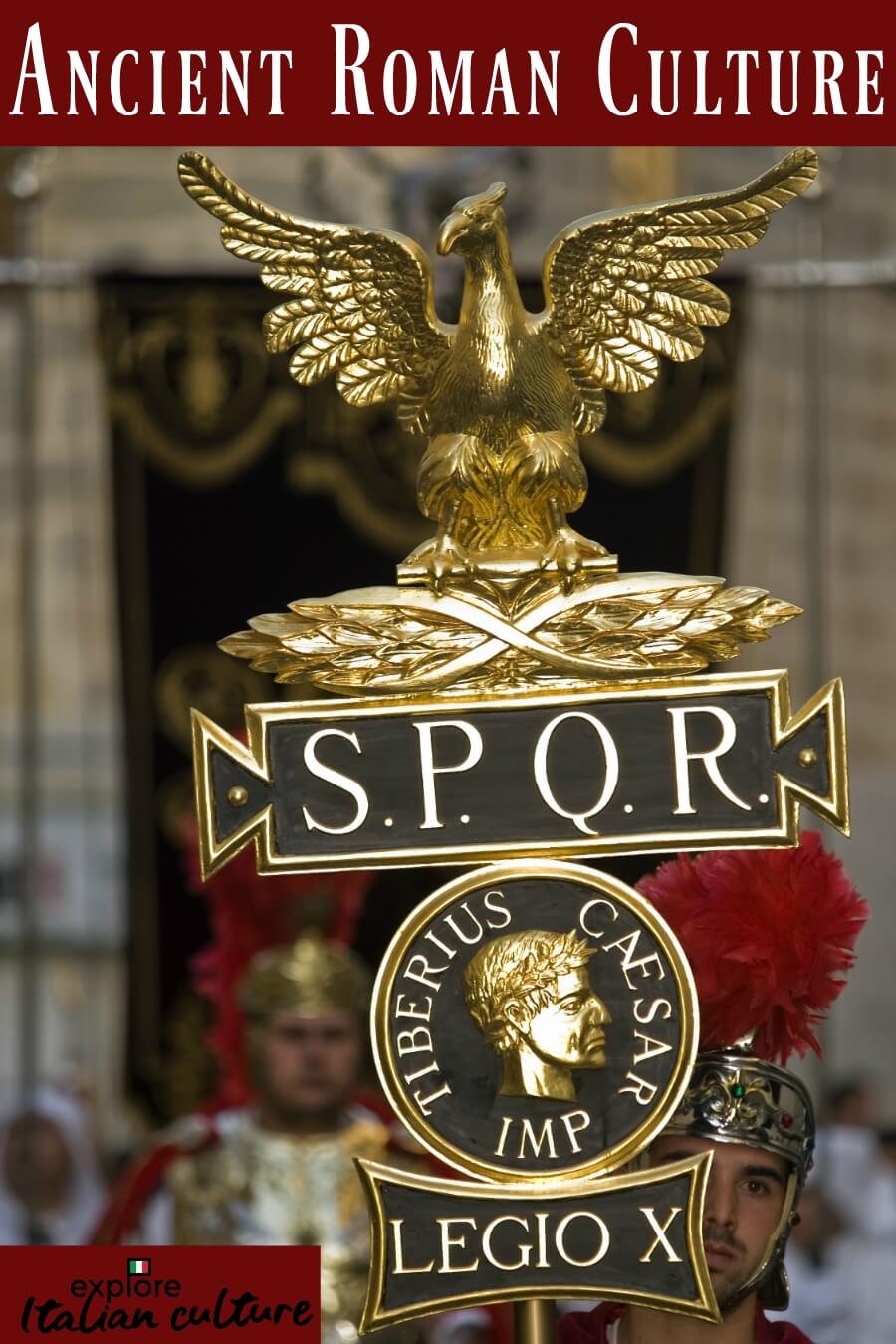
Gladiators in modern Rome
Ancient Roman culture comes to modern Italy.
Photo courtesy of Shelley's  'At home in Rome' blog.


If an ancient Roman found himself transported into our modern world he would probably feel a bit out of his depth. Vast technological differences, for example, might prove a bit overwhelming for someone who had spent his previous life counting with pebbles. But he would also find that much of the Italian culture, traditions and customs he comes across are very familiar to him. 


Italian culture starts with the history of ancient Roman culture and much of what we think of as modern invention and etiquette actually comes from the Italy of two thousand years ago.


Are you planning a trip to Italy? Thinking of getting married there? Wanting to buy some Italian jewelry? Before you do, use these pages to understand how the achievements and eccentricities of ancient Roman culture affect the Italy of today.


Ancient Roman culture - where was the Empire?

Map of ancient Rome.


If you're not sure where the Roman Empire was, start here.


At its peak in 116 A.D. the Empire spanned two and a half million square miles and was one of the largest empires in history. It managed to combine elements of tradition and culture from all its different territories.


In adopting the traditions of those separate peoples ancient Roman culture created a civilization which was a diverse and sometimes curious mixture.


This page gives a detailed map of the ancient Roman Empire with a key to the different areas.


Ancient Roman culture and modern traditions :

Ancient Roman weddings.


Guests at ancient Roman themed wedding
Ancient meets modern :  guests at an ancient Roman themed wedding.
By kind permission of Monica at FLickr.

If you're planning your wedding in Italy, or if you can't travel that far but would like an Italian-themed wedding in another country, this is the place for you.


We wanted to incorporate into our Rome wedding as many Italian wedding traditions as we could. To our surprise we discovered that many modern customs stem directly from the traditions of ancient Rome.


This page tells you all about the way ancient Roman weddings can be used to help create your own wedding, from engagement ring tradition and the origins of bachelor parties to Roman bridal fashion, the ceremony and the wedding feast.


Ancient Roman culture and 'la bella figura' :

Ancient Roman jewelry.


Gold snake cuff
Gold snake cuff,
1st Century A.D.
Picture courtesy of V-Roma.

If you want to know more about the origins of Italian jewelry and how to spot unique Italian design, this page is your starting-point.


You'll be in good company. In December 2008, when the then American President-Elect Barack Obama was looking for an unique gift to give to his wife for her support in his journey to the White House, it was to Italian jewelry designer Giovanni Bosco he turned.


Gold snake jewelry
A modern designer interprets the snake cuff : Roberto Cavalli's contemporay design.


Big, bold and sure to be noticed, Italian jewelry has always been ahead of its time. Modern design blends tradition with current trends and reworks techniques and materials from the culture of ancient Rome.


Contemporary Italian jewelry is a classic example of the new learning from the old and combining to make something exquisite.


Ancient Roman culture - the daily grind :

Ancient Roman daily life.


Ancient Roman food
Yumus yumus ... even Emperors had to eat.
If you plan to visit Rome with kids knowing some fun things about ancient Roman culture can make their experience much more enjoyable.


Dragging children round ruins can be tedious for them and for you - especially in the heat - but being able to tell them about Romans inventing the first doggy bags or to bring the Circus Maximus alive for them is to encourage their knowledge of ancient cultures without their realising that they are learning.


This page gives the first five of our strange facts about ancient Roman culture : why graffiti was as much a problem in ancient Rome as it is in Rome today; why the Circus Maximus still beats Rome's 'Stadio Olimpico' and why being an Emperor in ancient Rome was a very unhealthy occupation.


Ancient Roman culture - the daily grind (part 2) :

More facts about ancient Roman daily life.


Our final five strange facts about ancient Roman culture, including : Who wore what clothes? Is it true that Roman children used potties? And did postal codes really start in ancient Rome?


Have a look and be amazed!


Ancient Roman domestic culture :

Ancient Roman animals.


Like to know more strange facts about the history of ancient Roman animals and what they tell us about the Italy we visit and live in?


Giraffes or camel leopards
Perhaps you want to know more about Italian dog breeds, their history and the role they played in Roman society? Does history tell us which breed may be more aggressive or which are working dogs in need of lots of exercise? Are there any lapdog types originating in Italy?


Ancient Roman culture saw geese as guarding animals, elephants as transport to dinner parties, animal entrails used to foretell the future, even giraffes roaming the streets "raising its head to those onlookers at their windows ... the people think that they are looking at a tower rather than an animal. It even seems to watch with pleasure the people who come to look at it".


This page will give you information about animals in Italian culture - ancient and modern.


Ancient Roman culture and architecture :

Five strange facts about the Roman Colosseum.

Ancient Roman Colosseum
An instantly recognisable image.

There are plenty of guidebooks to give you all the historical and factual details you'll need, but if you're taking kids to see the Colosseum those facts can be a bit dry.


So we've put together ten strange facts which will bring the Colosseum to life for kids and make them want to see it. Even a little knowledge makes a visit there so much more interesting and enjoyable.


These are the first five of those strange facts : they include why the former arena of death is now a symbol of life; why ostriches were as important as lions; and what Sir Paul McCartney was doing there with a bike.


Ancient Roman culture and traditions :

Five more facts about the ancient Roman Colosseum.


And if you've enjoyed the first of our strange facts, here's some more information about the ancient Roman Colosseum which you may not have known before. They include why the film 'Gladiator' was made in Malta; why Beyoncé drank Pepsi there; and whether ancient Roman gladiators ate too much.


Ancient Roman culture and modern Italy :

Top Tips for visiting the Colosseum in Rome.


If you're planning to visit the Colosseum and want to know more before you go, this is the place for you. It's full of information and tips about where it is, how to get there, and how to avoid the queues when you do.


Ancient Roman culture and history :

Gladiator School.


If you're planning to visit the Roman Colosseum and taking kids with you, think about visiting Rome's 'Gladiator School' which caters for adults and children over the age of six. It starts with a lesson about the history of gladiators in the Roman Empire and their role in the Colosseum, and goes on to teach fighting techniques. Everyone who goes calls it the highlight of their trip to Rome.


This page will give you information about what it's all about, who it's suitable for, how much it costs and how to book.


Ancient Roman culture and traditions :

Ancient Roman baths.


Ancient baths
The ancient baths at Bath, U.K. - the best preserved Roman spa of them all.

Spa water has been used for curative purposes for two thousand years and we can see the influence of ancient Roman baths all over the world. Italy's numerous spa centres are often on the site of ancient baths, and the health benefits for us today are just as striking as they were for ancient Romans.


Mosaic from modern spa
Mosaic at modern spa.
By Rachel Sager mosaics.

But exactly why were ancient Roman baths such an important part of the Empire's culture? Why did the wealthy frequent public baths when they had their own in their homes? And do modern health centres have anything in common with ancient bathhouses?


This page looks at the similarities between ancient and modern spas : the buildings, their decoration and their purpose, and answers the question : "Have spas helped Italians through the ages to remain one of the healthiest nations?".


And, when you've finished reading about ancient Italy, why not try visiting?


Ancient Roman culture has left an indelible mark on the world since the Empire collapsed: ancient Roman buildings provide styles and techniques for buildings all over the world; many political and legal systems follow the ancient Roman model; the Latin language provides the basis for the Italian language amongst many others; many ancient Roman culture traditions have been adopted into our twenty-first century life.


The city of Rome's first inhabitants lived on the Palatine Hill just before the year 1000 B.C. and were farmers.  Today's Rome has become the world's most famous open-air museum. It's a stunning place to be. There's never any need to ask what to do in Rome - ancient Roman culture combines with the modern to make it one of the most fascinating cities in the world.


Visit Rome if you can. 

It will take your breath away -

and for that, we have ancient Roman culture to thank.


Rome, capital of Italy
Rome's immediately recognisable city skyline.


Interested to know more?

Here are some resources which are informative, accurate and accessible places to find more information about ancient Roman culture.


Books :

This one is our favourite :

Book recommendation
Ancient Rome on Five Denarii a Day  :  Philip Matyszak.
Published Thames and Hudson, May 2007.


A light-hearted but factually accurate book written from the perspective of a travel guide to ancient Italy.  Sections you would expect of any guide book to Rome : how to get there, what to see, places to avoid, communicating with the natives - but all written in the year (approximately) 200 A.D.


Easy to read, quirky and full of information about ancient Roman culture.  I particularly loved the 'useful phrases' section - from "conclave meum flagrans est" ("my room is on fire") to "utinam tuus currus deleatur" (may your chariot be wrecked") - everything you could possibly need to know!


Book recommendation
As the Romans Did - a Sourcebook in Roman Social History :
Jo-Ann Shelton.
Published Oxford University Press, 1998 (2nd Edition).


There is a huge amount of mis-information on the internet about ancient Roman civilization.  This book uses written Roman sources as a basis for all the facts it presents.


As you might expect from Oxford University Press, this is a more academic book than the others.  It contains a large number of English translations of a wide range of documents - letters, manuals, recipes, graffiti, and inscriptions as well as literary sources.


Together they offer a fascinating glimpse into a wide range of facts about ancient Roman daily life : family, housing,entertainment, health, education, religion, crime and other important topics. This is an unique introduction to ancient Roman culture, but don't expect to pick it up and read it from cover to cover in one go.  It takes concentration but is worth the effort.


Book recommendation
The Colosseum : Keith Hopkins and Mary Read.
Published Profile Books Ltd., February 1995.


A wonderful book by two leading historians which tells the story of the Colosseum through the ages : how it was built, how much it cost, the games held there, its after-life as a glue factory, how the Victorians dealt with it - the facts are endless. 


Good for dipping into, it's engaging and witty whilst at the same time covering all the facts.  It also dispels some widely-held beliefs about the Colosseum. 


If you're visiting the Colosseum this book will help you get your bearings; if you just want to know more about this era in ancient Roman culture, 'The Colosseum' is the book for you.


Websites :


This one is our favourite :

Website recommendation
V-Roma : www.vroma.org.

A group of teachers and students who create online resources about ancient Roman culture. The project was initially started in 1997 and has a wealth of good, accurate information on ancient Rome - many of the graphics on our site are from there.


The two major components of the project are its online learning environment which has received several very positive external reviews, and its collection of internet resources. All the resources on the site, including thousands of images, are freely accessible as long as the organisation is given due credit.


And finally, visit  :

Places to visit recommendation
Places :

The World Heritage Site of Pompeii.
The Roman Baths at Bath, U.K.


Museums :

  • The British Museum, London.
  • The Victoria and Albert Museum, London.
  • Museo Archeologico Nazionale di Napoli, Naples, Italy.
  • Museo Nazionale Romano, Rome.
  • Museo della Civiltŕ Romana, Rome.
  • San Antonio Museum of Art, Texas, U.S.

and of course, not forgetting :

ROME!


Back from ancient Roman culture to our home page
about modern Italian culture.


footer for ancient roman culture page