Helping travelers to Italy since 2008
Italian Engagement Ring Tradition - its place in Italian culture
Italian engagement ring tradition.
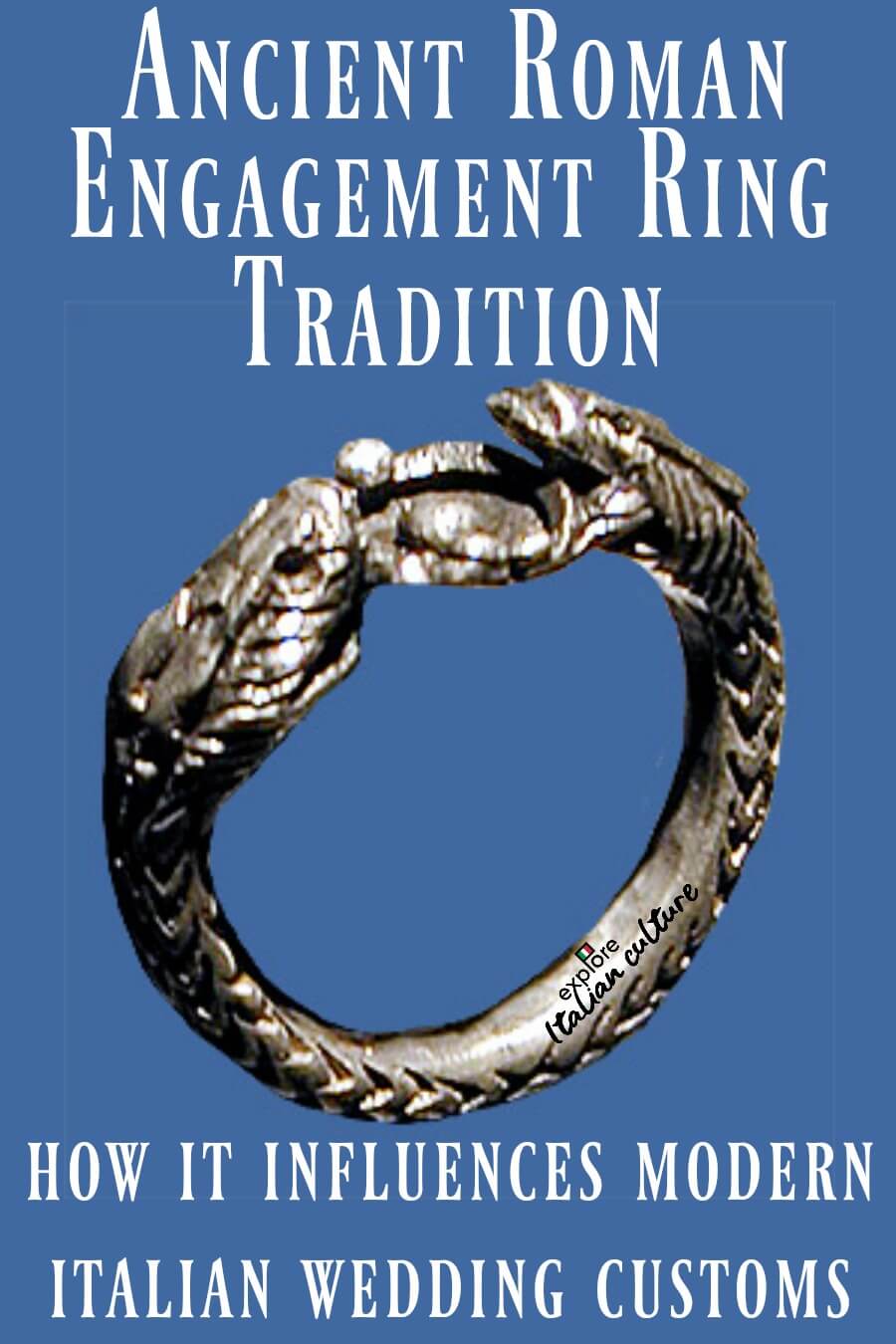
Did you know that the engagement ring tradition of Italian and other cultures began in ancient Roman times?
So if you want to reflect your Italian heritage in your plans for your marriage, here's where to begin.
We researched this information when we were planning our own Italian wedding. It's taken from academic studies about ancient Rome, and from our knowledge of engagements and weddings learned from Italian friends.
So you can be sure it's accurate.
Check availability and current special offers on Tours in Italy now!!
Italian Engagement Ring Tradition
The tradition of engagement rings began in ancient wedding culture but had nothing to do with either bridal fashion or love.
The groom gave a ring to his bride-to-be as a public mark that a formal contract of engagement had been made between the two families.
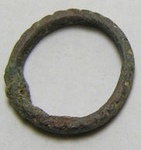 Iron Roman wedding band. Photographed at British Museum, London
Once given, the promise to marry became legally binding. Engagement traditions meant that, from this point on, only death was an acceptable reason for not continuing to marriage.
So the ring was not so much a decoration, but a very plain band made not of gold but of iron - a symbol of the lasting and unbreakable contract.
It was also a public sign that the woman was about to pass from the ownership of one man - her father - to another - her husband.
For that reason, men did not wear any form of engagement or wedding band.
Iron in modern Italian engagement ring traditions
How does that translate into modern Italian culture traditions? Bridegrooms in Italy often carry a small piece of iron in their pocket to symbolise the strength of the couple's commitment to each other.
In other countries the bride is given a horseshoe which, although traditionally signifying good luck, is also an iron symbol of strength.
But these days, it tends to be made of card.
Engagement ring tradition: from iron to gold
But iron rusts.
The ancient Romans were skilled goldsmiths who used advanced methods of creating beautiful ancient Roman jewelry. By the third century, plain silver and gold bands replaced iron as engagement rings.
This time they symbolised not just strength but the groom's faith in his bride-to-be: she could be trusted with his wealth.
Here, ancient Italian culture traditions were closer to modern times. Rings were now a symbol of a promise to marry and an expression of trust.
But where was love in all of this?
The engagement traditions of 'fede' rings
 An ancient Roman
'fede' ring
An ancient Roman
'fede' ringNo doubt experimenting with their goldsmith craft, the ancient Romans then developed from a simple band to a more elaborate design of a gold signet design showing hands clasped, or a couple entwined.
They named this the 'Concordia' or harmony ring, but the design also became known as the 'fede' ring.
So the symbolism was broadened yet again and 'engagement' rings now spoke of strength, a promise to marry, trust, harmony and 'fede', meaning a pledge of love.
In Italy today 'fede' is what a wedding band is called.
On top of that, rings were now worn on the third finger of the left hand. In this, ancient Roman culture followed the Egyptian belief that from that finger ran the "nerve of love" directly to the heart.
At last, the engagement ring spoke of love.
'Fede' rings in modern Italian engagement traditions
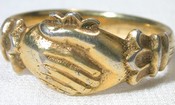 Today's fede ring
The 'fede' is still very much a part of Italian engagement ring tradition, particularly in the northern regions where it appears as either two clasped hands or two hands holding a heart.
It's used as either an engagement or wedding band and is popular in both silver and gold.
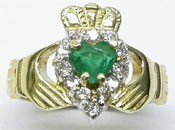 The Irish Claddagh ring
Not just in Italy either; the famous Irish version of 'fede' rings is the Claddagh, taken directly from ancient Roman culture: two hands, holding a heart, topped with a crown symbolising loyalty.
The Claddagh has become very popular as a wedding or engagement pledge, and a friendship, or loyalty, ring.
Diamonds in engagement ring tradition
The ancient Romans loved diamonds. They endowed them with romantic powers, believing they were splinters from falling stars that tipped the arrows of Eros, the god of love.
But despite that, and despite having free access to gems from all parts of the Roman Empire, the tradition of having a diamond in engagement rings did not originate in ancient Roman culture.
The diamond engagement ring as we know it was not seen until the Italy of the 1400s.
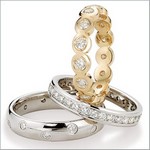 Italian wedding rings
by 'Preziosi'
Italian wedding rings
by 'Preziosi'But once they discovered the beauty of diamonds in rings, Italian jewellery manufacturers embraced diamonds enthusiastically in both engagement and wedding rings.
Modern Italian engagement rings now feature diamonds in a variety of settings, and Italian wedding rings are also often diamond set with a single stone for a man and a circle of stones, signifying eternal love, for the bride's band.
As for ancient Roman wedding rings, they did not exist as a separate item.
The engagement band was worn by the woman as a sign of her betrothal and, later, her status as a wife. No other ring was exchanged at an ancient Roman wedding.
Translating ancient engagement ring tradition into Italian culture today
So, what should you be thinking about if you want to use some of the traditions of ancient Roman engagement traditions in your own ceremony?
Here are some suggestions:

Use a 'fede' or Claddagh as your engagement ring. If you opt for the heart shape, make sure you wear it with the heart's point turned inwards towards your body. This symbolises that your heart is taken.
Use your engagement party to give and receive your engagement band formally, as a public commitment to your promise to marry.
It is part of Italian cultural traditions that, if the man's family owns a particular ring they leave it to their eldest son. He will then give it to his fiancée as a symbol, not just of love, but signifying a welcome into her new family.
So don't be offended if you're given a family heirloom as an engagement or wedding ring.
It is customary in Italy to engrave the date of the marriage inside wedding rings, adding the bride’s name inside the groom’s, and his name inside hers.
Want to know more about how ancient Roman culture impacts Italian traditions today? Try these articles!




Don't let toothache ruin your vacation!

Do you have toothache? As a dentist, I know how tooth pain can seem to dominate every moment of your day. In my 82-page e-book, I explain what's going on and what to do.
- Why you have pain
- How to tell if you have a tooth infection
- Home remedies that work
- When to seek professional care
- Real-life examples, simple steps
Reclaim your comfort - Click for
full details and buy instantly!
On special at $17.50, until end of April 2026 (RRP $33.50)

Click here or the banner below to read more about tours in Italy!
Save Money And Precious Time With Our Italian Cheat Sheets - Etiquette, and Insider Tips For Rome.

CLICK HERE TO VISIT OUR
ITALIAN ETIQUETTE CHEAT SHEET INFORMATION PAGE.
CLICK HERE TO DISCOVER A HIDDEN SIDE OF ROME -
Tips From An Insider!
Recent Articles


-
Best Italian Pasta Recipes: How To Make Pasta For Delicious Meals.
Apr 22, 26 02:40 PM
The BEST Italian pasta recipes. Each authentic recipe has been handed down from friends in Italy and tried and tested by us! -
The Latest News From Italy For Tourists And Visitors 2026
Apr 09, 26 11:47 AM
 Find out about the latest news from Italy that may affect your travel arrangements and your visit once you are there. Latest updates 2026.
 -
May Day Italy 2026! Does Italy close down on May 1st? Find Out Here!
Apr 04, 26 10:38 AM
 May Day in Italy: transport, restaurants and banks: what's open, what's not - and how to celebrate May Day Italy.


You can book a Pompeii Small Group Tour with an Archaeologist through our trusted partner Viator.