- Home
- ALL The Facts About Italy
- Authentic Italian Recipes
- The Mediterranean Diet
- All about Rome
- Holiday Celebrations In Italy
- Animal Fact File Italy
- What To Buy in Italy
- Rome Cheat Sheet
- Italian Etiquette Cheat Sheet
- Latest News From Italy
- Photo Competition
- Quotes About Italy
- Romantic books set in Italy
- Rome's free water fountains
Helping travelers to Italy since 2008
- Home
- Facts About Italy
- Italian Flag
The Italian flag: facts, colors and symbolism.
The Italian flag.
You'll see the national flag of Italy everywhere you go in the country, and not just flying from buildings!
Since the days of ancient Rome, flags and
coats of arms have held a special place in the symbolism and culture of
Italy. The present day national flag is no exception.
Look out for it making an appearance in clothes, shoes, pasta, pizza, salads - even gelato! It's such an important part of life in Italy that it's worth knowing something about it before you visit.
Here, we explain:
- the meaning of the Italian flag
- the history of the Italian flag, and
- facts about the Italian flag.
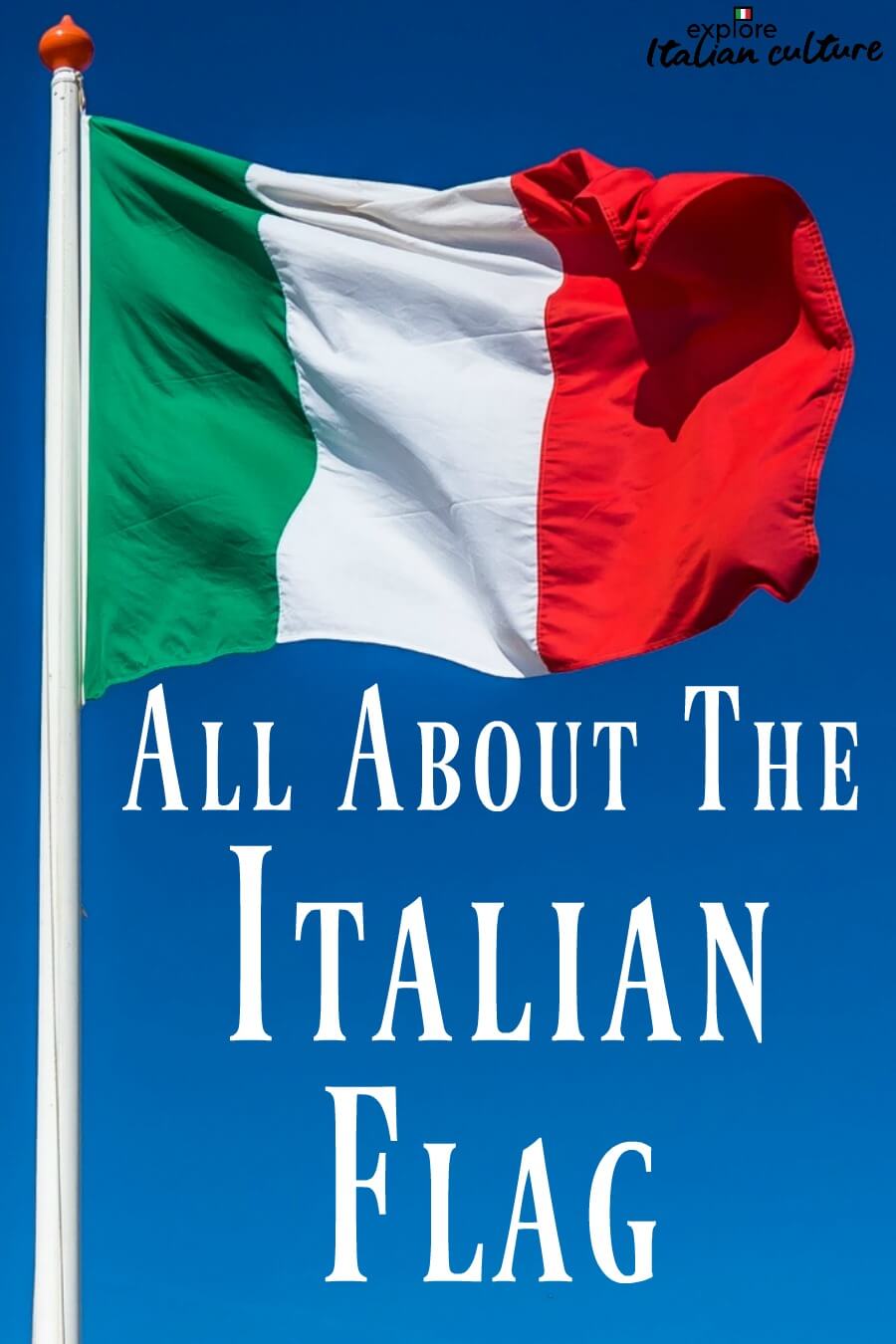
The Italian flag: colors
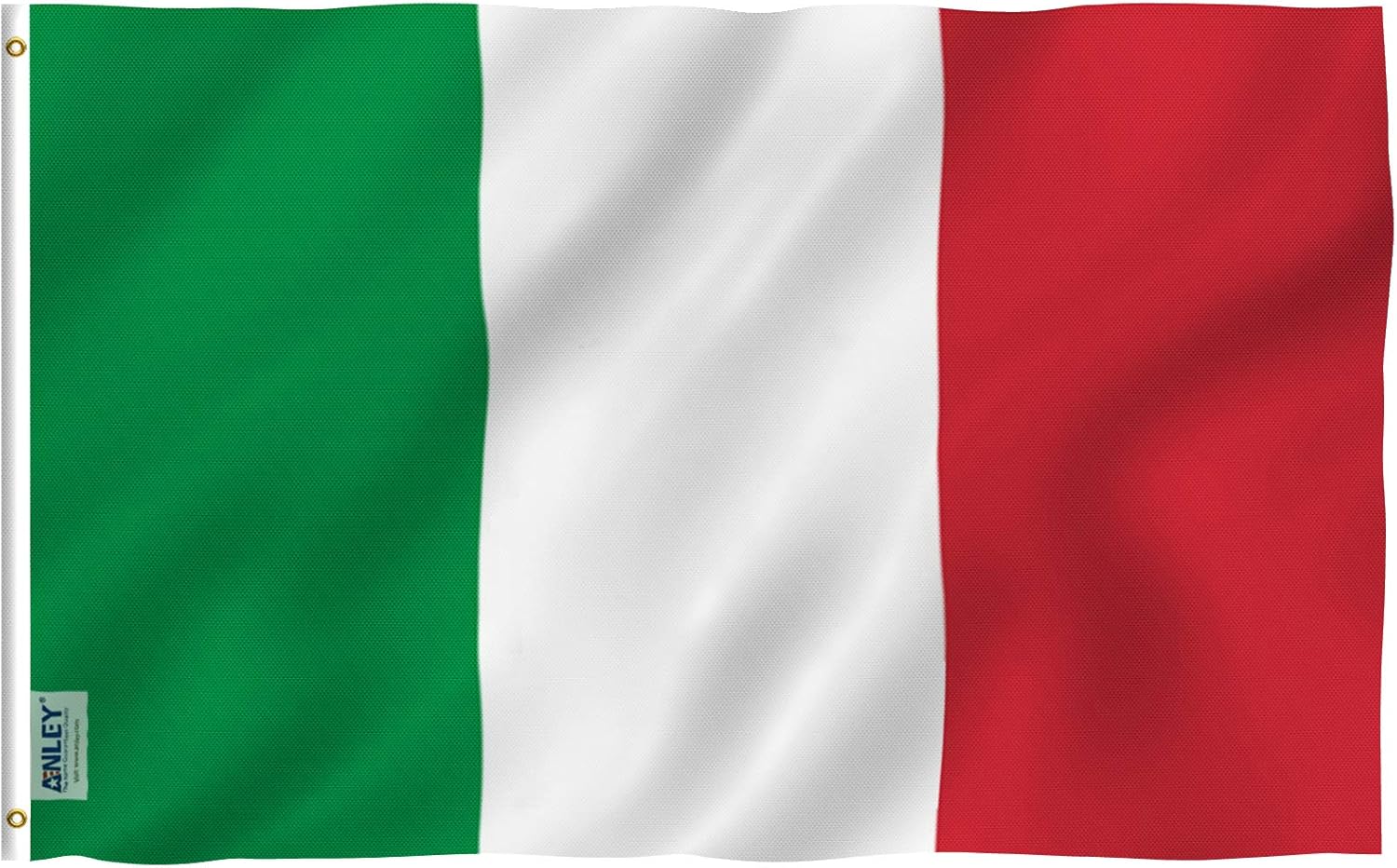
The Italian flag is a three-colored flag, also called tri-color (in Italian, 'Il Tricolore', pronounced "Eel Tree-col-aw-ray").
The three vertical stripes are the same size, and the colors are green, white and red.
The green stripe is always placed nearest to the flagpole.
Don't mix up the Italian flag with those of ...
- Ireland, which is longer and green, white and orange;
- Mexico, which is also longer, uses darker shades of red and green and has a coat of arms on the white stripe;
- or the Côte d'Ivoire, which has the colors reversed and is orange, white and green.
Check availability and current special offers on Tours in Italy now!!
History of the Italian flag
The colors were first adopted by the military in 1796, but it didn't fly as a civilian flag until 1797 when, with its arms and crown in the centre, it was adopted by the Cispadane Republic - a short-lived republic in the north of Italy.
When Italy became a Republic in June 1946, it adopted the simple "Tricolore" with no coat of arms. So in its present form, it's been the national flag for only a relatively short time.
Meaning of the Italian flag
As ever, there's some controversy about the flag's colors.
Its military origins have encouraged some to think that its design is based on the colors of Milan (red and white) and the Milanese civic guard (green). There's also a religious interpretation whereby green represents hope, white, faith and red, charity.
But that's a bit mundane for the people of Italy. They prefer a more romantic explanation.
The most popular - which has become the accepted fact - is that the colors represent Italy itself: white for the snowy Alps and other mountain regions; green for the plains and the hills; and red for blood spilt in the Italian wars of independence.
Which is right? Whichever you choose!
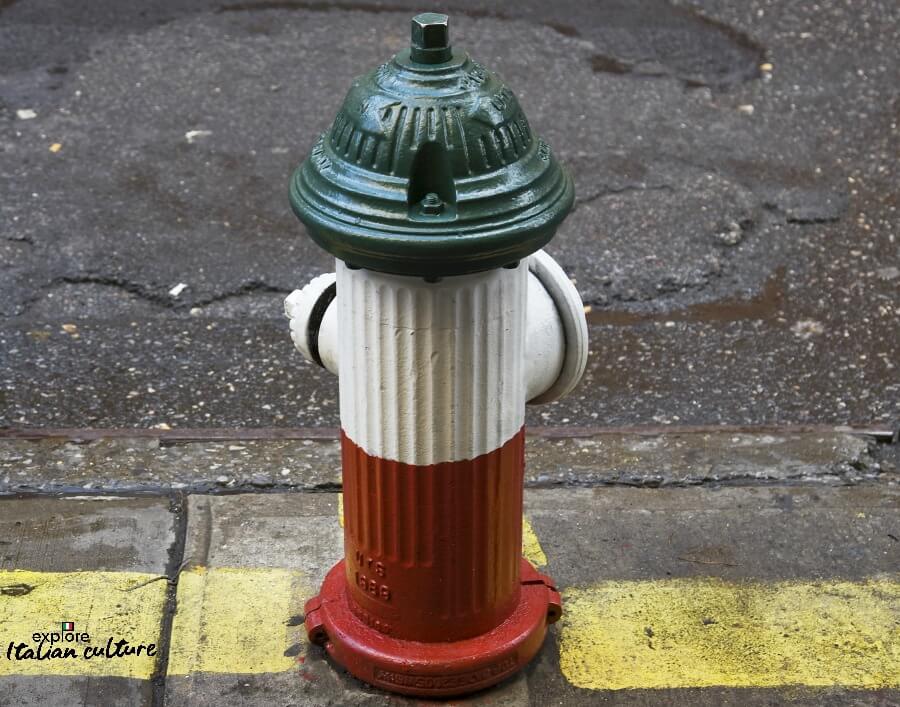 Even the fire hydrants are patriotic in Italy!
The Italian flag colors: controversy.
One thing is for certain: the Italian people take their flag's colours very seriously. When President Silvio Berlusconi tried to introduce a subtle change of colour, he was accused of attempting a "chromatic coup d'état". The people were not amused.
Politicians and people alike were furious. So outraged, in fact, that the country actually considered a national referendum to allow the public to choose the right shades.
But Berlusconi, sensing a revolt, backed down. The referendum was never needed!
Facts about the Italian flag
As in any country, the flag is flown at ceremonial occasions and on government buildings.
It's unusual for Italians to fly their flag on their houses or in their garden in the way families in the United States do.
The exception to that is when the national football (soccer) team is doing well in any tournament. At that point, you'll see the flag everywhere: draped from windows, flying from cars and wrapped around supporters.
What's its relationship to
the European Union flag?
This is the other flag you'll see on your travels in Italy.
 The European Union flag
In Italy, the flag of the European Union - twelve golden stars on a blue background - must be flown alongside the national flag over public buildings and at official ceremonies.
It's optional in other situations, though the two flags are often flown together as a symbol of Italy's allegiance to the Union.
The Italian flag and food!
But in Italy, the flag is used for much more than just for flying. They don't make a big deal of it, but Italian people love their flag, and love to show it - although almost always in a cleverly understated way.
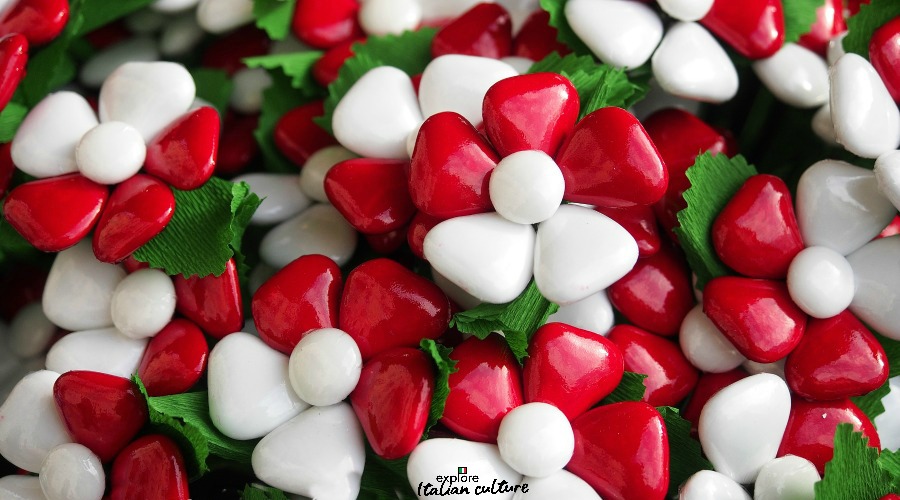 Sugared almonds (known in Italy as "confetti") from Sulmona, in the colours of the Italian flag.
Its colors feature in everything from footballs to ice cream, pizza and salads. It's most in evidence at football matches, it flies from public buildings, it's used as a design feature for clothing and all manner of private and civic celebrations.
And often, in the Italians other great love - food.
Pizza Margherita was originally made in Naples for a visit of Queen Margherita of Savoy, in the colours of the Italian flag. So, red tomatoes, white mozarella cheese and fresh, green basil.
It remains a firm favorite amongst the many pizzas eaten in Italy today. You're bound to see it during your stay - give it a try. It's simple, and simply delicious!
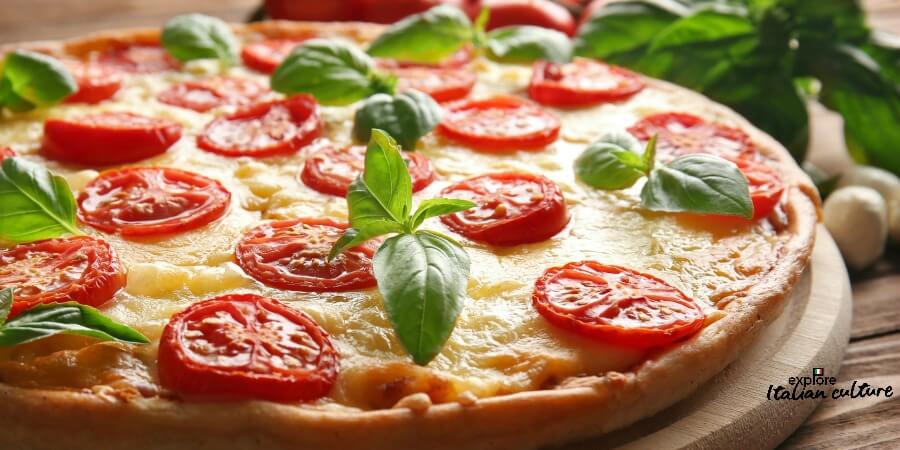
And then there's that other food standard, the Caprese Salad. Same ingredients: tomatoes, mozarella, basil. Usually served arranged in those colored rings on a plate. Sometimes, though, with a variation on how it's served.
But never a variation in the colours. Caprese salad is always in the flag's colours. If there's any added color, it's not a true Caprese.
That doesn't mean you can't be adventurous, though. Try it like this - as Caprese kebabs. Delicious, and always adds a dash of color to a buffet table.
 Caprese salad as kebabs
Where to buy the Italian flag
If you're in Italy, any of the thousands of souvenir shops will sell you one. If you happen to be there when the national football (soccer) team is playing, the stands outside the ground sell them.
And if you're not in Italy, the obvious answer is Amazon.
CLICK HERE to purchase your flag on Amazon.
Top Tip
Never disrespect the Italian flag when you're visiting Italy. It's illegal even to verbally dishonor it, or any national flag, and can result in a heavy fine.
Physically damaging the Italian flag is punishable by imprisonment.
Remember to visit our page on facts about Italy for more information!
If you liked this page, you may find these interesting.
Just click on any of these buttons to go to an article about it.



Check availability and current special offers on Tours in Italy now!!

Click here or the banner below to read more about tours in Italy!
Save Money And Precious Time With Our Italian Cheat Sheets - Etiquette, and Insider Tips For Rome.
CLICK HERE TO VISIT OUR
ITALIAN ETIQUETTE CHEAT SHEET INFORMATION PAGE.
CLICK HERE TO DISCOVER A HIDDEN SIDE OF ROME -
Tips From An Insider!
Recent Articles


-
How to navigate Fiumicino airport Rome in 2026
Jun 02, 26 06:51 AM
 Fiumicino airport outside Rome is one of the best airports in the world; with careful planning you can get through it and into Rome fuss-free. We show you how.
 -
The Latest News From Italy For Tourists And Visitors 2026
May 27, 26 07:50 AM
 Find out about the latest news from Italy that may affect your travel arrangements and your visit once you are there. Latest updates 2026.
 -
Best Italian Pasta Recipes: How To Make Pasta For Delicious Meals.
May 27, 26 07:31 AM
The BEST Italian pasta recipes. Each authentic recipe has been handed down from friends in Italy and tried and tested by us!


You can book a Pompeii Small Group Tour with an Archaeologist through our trusted partner Viator.